Elegant Floral Line Art
Line art has long been a quiet powerhouse in visual design—clean, expressive, and endlessly adaptable. Elegant Floral Line Art elevates that simplicity with intention: delicate stems, balanced petal curves, and subtle asymmetry that feels both timeless and contemporary. It’s not just about drawing flowers—it’s about capturing botanical grace with minimal strokes, where negative space carries as much meaning as the line itself.
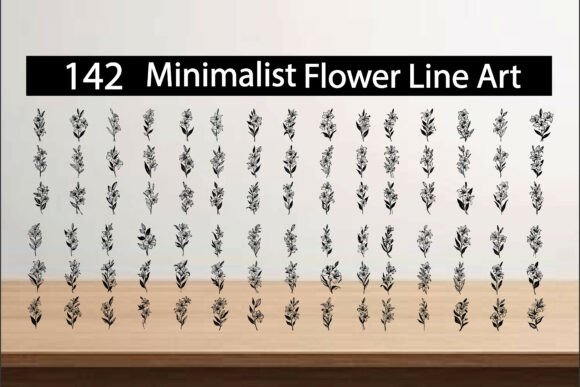
This isn’t decorative filler. It’s precision-crafted visual language—designed for clarity at any scale, from a 2mm journal sticker to a 48-inch wall mural. The 142 premium designs in this collection were developed with real-world use in mind: no redundant flourishes, no fragile details that vanish when scaled down or cut on vinyl, and no stylistic inconsistencies that break cohesion across a project.
Why These Designs Work Where Others Don’t
Many floral vector packs sacrifice versatility for ornamentation—overly detailed petals, inconsistent stroke weights, or tangled compositions that don’t translate cleanly to cutting machines or sublimation transfers. Elegant Floral Line Art avoids those pitfalls by prioritizing three practical foundations:
- Consistent stroke weight (0.25–0.75 pt) for crisp laser cuts, smooth Cricut/Silhouette paths, and legible small-format prints.
- Open, uncluttered forms—no overlapping layers or embedded raster elements—so every file remains fully editable in Illustrator, Inkscape, or Affinity Designer.
- Botanically grounded shapes—recognizable daisies, eucalyptus sprigs, peonies, wild roses, and ferns—not abstract approximations—making them instantly relatable for wedding stationery, educational printables, or nature-themed branding.
Each of the 142 designs is delivered in six production-ready formats: AI, EPS, SVG, PDF, PNG, and JPG. That means you’re never choosing between quality and convenience. Need transparent web graphics? Use the PNGs. Prepping for large-scale fabric printing? Pull the high-res EPS or PDF. Running a batch cut on your Cameo? The SVGs load instantly with clean nodes and no hidden groups.
Creative Uses—Beyond the Obvious
Yes, these work beautifully on t-shirts, mugs, and greeting cards—but their real strength lies in how they support *systems*, not just one-offs.
For educators and homeschoolers: Print the PNGs at 300 DPI onto cardstock, laminate them, and use them as tactile sorting tools for plant biology units—group by symmetry, pollination type, or native region. The clean lines make botanical features easy to trace, label, or annotate.
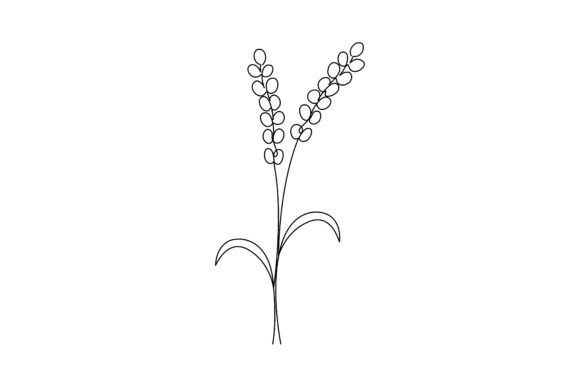
For small business owners: Combine three line art motifs—a lavender sprig, a simple bud, and a curved stem—to build a custom brand pattern for packaging tissue, invoice headers, or social media banners. Because all files share the same stroke language and spacing logic, they align intuitively without manual tweaking.
For wedding professionals: Layer the SVGs into Canva or Adobe Express to create cohesive suites—save the same peony motif as a monogram frame (SVG), a foil-stamped detail on menu cards (PDF), and a laser-cut acrylic place card accent (AI). No style drift. No mismatched weights.
Practical Tips for Consistent Results
Even great assets need thoughtful handling. Here’s what experienced users do differently:
- Start with the AI or EPS files when editing—these retain full vector fidelity, including editable text paths and anchor point control. Save exports (JPG/PNG) only after final adjustments.
- Use the SVGs exclusively for digital cutting—but first open them in your machine’s software and verify “cutting order” and “node simplification” settings. Many users skip this step and end up with jagged cuts or double-traced outlines.
- For sublimation or DTG printing, convert the PDF or EPS to CMYK *before* exporting to JPG/PNG—and always embed color profiles. The included JPGs are RGB-optimized for screen; they’ll shift if printed without conversion.
- When building scrapbook kits or sticker sheets, group related motifs (e.g., “spring bouquet set”: tulip + hyacinth + grass cluster) in separate layers before exporting PNGs. This keeps your source files organized and makes future edits faster.
Audience-Specific Adaptations
Freelance designers often use these as “foundational elements”—dropping a single line-drawn leaf behind client typography to add organic warmth without competing for attention. Bloggers embed the SVGs directly into WordPress posts (using inline SVG code) for lightweight, responsive illustrations that scale flawlessly on mobile.
Tattoo artists appreciate the minimalist accuracy: each bloom is drawn with intentional negative space, making it easier to adapt to skin curvature or integrate with lettering. A single-line jasmine vine, for example, flows naturally around a wrist or collarbone—no redrawing needed.
DIY crafters rely on the PNGs with transparent backgrounds for printable iron-on transfers. Because the line weight stays legible even at 1.5-inch height, tiny floral accents hold up on tote bags, aprons, or ceramic tiles—no blurring, no pixelation.
What Makes This Bundle Stand Out Long-Term
It’s not the quantity—it’s the curation. You won’t find 20 near-identical daisies here. Instead, there’s deliberate variation: closed buds versus open blooms, upright versus cascading stems, single specimens versus clustered arrangements. That range lets you build visual rhythm without repeating motifs.
All 142 designs support commercial use—no attribution required—so whether you’re selling POD wall art on Etsy, licensing botanical patterns to stationery brands, or creating branded workshop handouts, you retain full rights to the final derivative work.
And because everything is delivered as an instant digital download—no physical shipping, no waiting—you can begin testing ideas today: mock up a candle label in Illustrator, test a Cricut cut on scrap vinyl, or drop a floral frame into a Canva newsletter template—all before lunch.
Elegant Floral Line Art doesn’t ask you to chase trends. It gives you reliable, refined components—so your focus stays where it belongs: solving problems, expressing ideas, and making things that matter to real people.