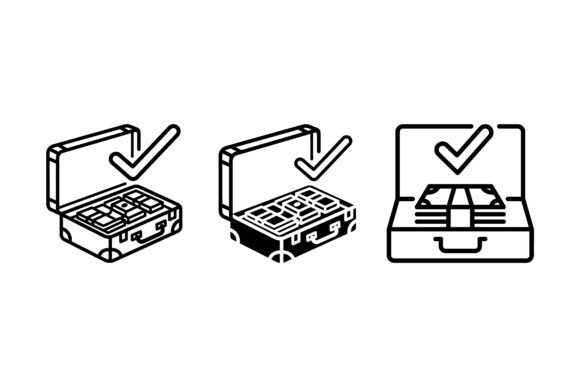
Money Briefcase Approved Checkmark Icon: A Tool for Streamlined Approval and Verification
The Money Briefcase Approved Checkmark Icon is a visual symbol designed to represent verification, approval, and confirmation in financial or business contexts. This icon typically features a briefcase filled with cash bundles, accompanied by a checkmark above it. It serves as a clear indicator of completion, validation, or acceptance—making it an essential asset for professionals who rely on visual cues to manage workflows efficiently.
Where the Icon Fits in Broader Processes
In many professional environments, the need to confirm the accuracy or validity of a transaction, decision, or task is critical. The Money Briefcase Approved Checkmark Icon fits seamlessly into these scenarios by providing a visual confirmation that a step has been completed successfully. Whether it’s verifying a payment, confirming a contract, or validating a budget, this icon acts as a silent but powerful signal that the process is moving forward without errors.
For instance, in project management, this icon can be used to mark tasks that have been reviewed and approved by stakeholders. In finance, it might appear alongside invoices or payment confirmations to indicate that funds have been processed. Its presence reassures users that their actions are recognized and accepted, reducing the need for further clarification or documentation.
Three Variations for Different Needs
The Money Briefcase Approved Checkmark Icon comes in three distinct styles: outline, solid, and flat front-facing. Each variation offers unique benefits depending on the context in which it is used.
- Outline Style: This version is ideal for minimalist designs or when you want to maintain a clean, unobtrusive look. It works well in digital interfaces where the focus is on functionality rather than visual impact.
- Solid Style: The solid version provides a strong, confident appearance. It's perfect for situations where the icon needs to stand out and convey certainty, such as in presentations or marketing materials.
- Flat Front-Facing Style: This style is versatile and modern, making it suitable for both web and print applications. It maintains clarity while offering a contemporary aesthetic that aligns with current design trends.
Choosing the right variation depends on your workflow and the message you want to communicate. For example, the outline style might be more appropriate for a dashboard where icons need to be easily distinguishable at a glance, whereas the solid style could be better suited for a branding toolkit where consistency and boldness are key.
Integration into Workflows
The Money Briefcase Approved Checkmark Icon can be integrated into various stages of a project or task. Before starting a new initiative, it can serve as a visual reminder that all necessary approvals have been obtained. During execution, it can be used to highlight completed milestones or verified steps. After completion, it can act as a final confirmation that everything has been processed correctly.
One practical use case is in the approval process for financial transactions. When a payment is made, the icon can be placed next to the transaction record to indicate that it has been confirmed. Similarly, in content creation workflows, it can be used to mark articles or reports that have passed quality checks and are ready for publication.
Another scenario involves team collaboration. By incorporating the icon into shared documents or project management tools, team members can quickly identify which tasks have been approved and which still require review. This reduces confusion and ensures that everyone is aligned on the status of ongoing work.
Compatibility and Usability
When selecting an icon like the Money Briefcase Approved Checkmark Icon, compatibility with different platforms and tools is essential. The outline, solid, and flat variations should work across a range of applications, from website design to mobile apps and printed materials. Ensuring that the icon remains legible and recognizable at different sizes and resolutions is crucial for maintaining its effectiveness.
Usability also plays a role in how the icon is implemented. It should be placed in areas where it can be easily seen and understood without requiring additional explanation. For example, placing the icon near a payment button or a confirmation message helps users associate it with the correct action or outcome.
Additionally, the icon should be used consistently throughout a design system or workflow to avoid confusion. If it appears in one context as a green checkmark and in another as a red X, it may lose its intended meaning. Maintaining a uniform style reinforces its purpose and makes it more intuitive for users.
Practical Implementation Tips
To implement the Money Briefcase Approved Checkmark Icon effectively, consider the following tips:
- Use it in conjunction with text: While the icon conveys a message visually, pairing it with descriptive text ensures clarity, especially in contexts where the icon alone might be ambiguous.
- Test across devices: Ensure the icon looks good on both desktop and mobile screens. It should remain clear and readable even when scaled down.
- Consider color contrast: Choose colors that provide sufficient contrast against the background to ensure visibility, particularly for users with visual impairments.
- Keep it simple: Avoid overcomplicating the design. A clean, straightforward icon is more effective than one that tries to convey too much information at once.
These practices help maintain the icon’s utility and ensure it functions as intended in diverse environments.
Long-Term Use and Quality Control
When using the Money Briefcase Approved Checkmark Icon in long-term projects or repeated workflows, quality control becomes important. Over time, inconsistencies in placement, size, or style can lead to confusion or diminish the icon’s impact.
Establishing a style guide or design system that includes the icon ensures that it is used consistently across all platforms and materials. Regular audits of how the icon is applied can help identify any deviations and correct them promptly.
Moreover, staying updated with design trends and user feedback can help refine the use of the icon. As workflows evolve, so too should the way the icon is integrated into them. Flexibility in its application allows it to remain relevant and useful over time.
Conclusion
The Money Briefcase Approved Checkmark Icon is more than just a visual element—it’s a tool that enhances communication, streamlines processes, and improves efficiency. Whether used in financial transactions, project management, or creative workflows, its ability to convey approval and verification makes it a valuable addition to any professional toolkit.