Water Treatment Facility Vector Icon: A Practical Design Asset for Technical and Creative Projects
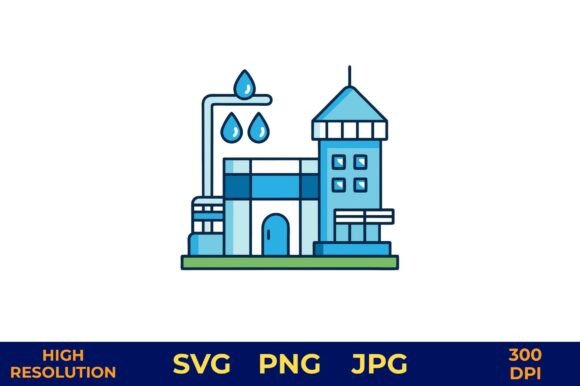
A Water Treatment Facility Vector Icon is more than a stylized graphic—it’s a precision-crafted visual tool designed for clarity, scalability, and professional reuse. Unlike generic water or infrastructure icons, this specific vector illustration centers on an industrial water treatment plant: twin cylindrical towers, pipework, control elements, and stylized blue water droplets integrated into the composition. Its purpose isn’t decorative abstraction but functional representation—ideal when accuracy, technical resonance, or environmental messaging matters.
What You Actually Receive—and Why It Matters
You get one cohesive design delivered in three widely compatible formats: SVG (scalable, editable, lightweight), PNG (high-res raster with transparency), and JPG (standard web/print use). All files are sized at 4200px × 4200px and rendered at 300 dpi—meaning crisp output whether printed on a 24" poster or scaled down to a 64px social media badge. The transparent background is non-negotiable for professional integration: it eliminates clipping masks, layering friction, or white-box artifacts when placed over gradients, photos, or textured surfaces.
This isn’t a bundle of loosely related assets. It’s a single, unified vector illustration—consistent in line weight, color harmony (cool blues, clean grays, subtle metallic accents), and industrial aesthetic. That cohesion supports branding continuity across touchpoints, especially where visual tone must align with themes like sustainability, municipal infrastructure, public health, or engineering education.
Real-World Usability Across Workflows
In practice, the Water Treatment Facility Vector Icon performs reliably where many generic icons falter. Its 300 dpi resolution and vector foundation mean it holds up in print-heavy contexts: municipal reports, utility brochures, or educational handouts distributed to schools or community centers. Because it’s built at high resolution from the start—not upscaled—the fine details in tower textures, pipe joints, and droplet contours remain legible even at small sizes (e.g., 120px wide in a digital dashboard).
Designers using Adobe Illustrator or Affinity Designer can ungroup and edit individual components—adjusting tower height, recoloring droplets, or isolating elements for custom infographics. SVG users benefit from CSS control: changing fill colors dynamically for dark-mode interfaces or accessibility-compliant contrast shifts. For non-designers—educators, local government staff, or NGO communicators—the included PNG offers plug-and-play utility in PowerPoint, Canva, or Google Slides without requiring software expertise.
Where This Icon Delivers Clear Value
Environmental and Municipal Communicators find immediate utility. A city water department updating its annual report can embed the icon beside sections on filtration upgrades or watershed protection—adding visual specificity without licensing risk. Similarly, NGOs producing awareness materials about clean water access use it to symbolize infrastructure investment rather than abstract “water drops” that lack contextual grounding.
Educators and Curriculum Developers integrate it into science units on the water cycle, civil engineering, or public health. Unlike cartoonish clip art, this icon conveys real-world scale and process—supporting conceptual understanding while maintaining visual polish in student-facing worksheets or presentation decks.
Creative Professionals working across branding, packaging, or event design also gain flexibility. Florists designing eco-conscious wedding stationery might layer the icon subtly behind botanical motifs on a “Save the Date” card. Planners creating printable kits for sustainability-themed workshops use it as a header element—its clean lines pair well with sans-serif typography and muted palettes. Even photographers documenting infrastructure projects may license it for client-facing presentations to visually anchor technical narratives.
Strengths Beyond Aesthetics
The Water Treatment Facility Vector Icon excels in consistency and reliability. Its balanced composition avoids visual clutter—no excessive shadows, gradients, or noise that degrade at small sizes or in monochrome printing. The blue water droplets aren’t tacked on; they’re rhythmically spaced and proportionally integrated, reinforcing function without sacrificing minimalism.
It’s also format-resilient. The SVG retains full editability in modern browsers and design tools. The PNG preserves transparency and sharpness without compression artifacts—even after multiple saves. And because all versions share identical dimensions and alignment, swapping between them mid-project introduces no layout drift—a practical win for teams juggling tight deadlines and cross-platform deliverables.
Practical Considerations and Limitations
This is a single-icon asset—not a library. If your project demands variations (e.g., night-mode version, isometric view, animated SVG), you’ll need to adapt it manually or source complementary assets separately. It’s also strictly illustrative: it doesn’t include data layers, interactive hotspots, or embedded metadata—so it won’t replace GIS overlays or smart diagrams in technical documentation.
While versatile, its industrial character means it’s less suited for playful, child-focused, or highly abstract contexts. A kindergarten water conservation poster might benefit more from friendly, character-based illustrations. Likewise, ultra-minimalist brand identities leaning into negative space may find the towers’ structural detail too literal.
Who Benefits Most—and When to Use It
Professionals who regularly bridge technical content and visual communication gain the strongest ROI. Think: municipal communications officers preparing public notices about plant upgrades; STEM educators building lesson kits on wastewater management; sustainability consultants designing client reports; or freelance designers crafting branded materials for environmental nonprofits.
It’s particularly effective when visual shorthand must convey both function (treatment, purification, infrastructure) and trust (precision, reliability, scientific rigor). In contrast, purely decorative applications—like background patterns or textile repeats—may underutilize its strengths. Its value peaks when deployed with intention: as a focal point in an infographic, a consistent motif across a campaign, or a signature element in a resource guide.
Final Recommendation: Fit Over Flash
If your work involves explaining, promoting, or educating around water systems—and you need a visual that’s accurate without being clinical, scalable without losing nuance, and ready-to-use without extensive editing—the Water Treatment Facility Vector Icon fits naturally into existing workflows. It’s not flashy, but it’s dependable. Not trendy, but it’s timeless in application. And unlike many digital assets that demand compromise—between size and quality, simplicity and specificity, or versatility and authenticity—this one balances those trade-offs thoughtfully.
For creators who prioritize clarity, consistency, and quiet professionalism over novelty, it’s a quietly effective tool—one that earns its place not through attention-grabbing flair, but through steady, repeatable usefulness across real projects.