FREE Sketch Silverfish Icon: Clean, Scalable, and Ready for Real Use
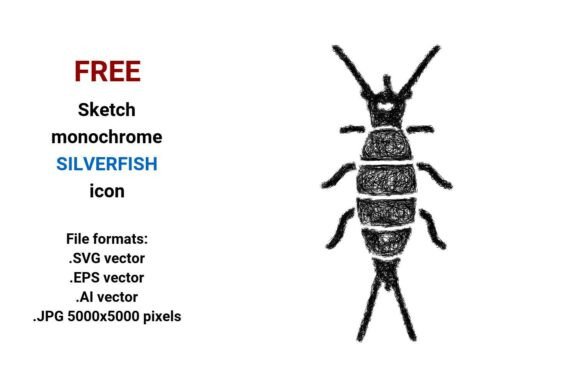
If you're designing a pest control website, building an educational resource about common household insects, or creating an app interface that needs a subtle yet recognizable symbol — the FREE Sketch Silverfish Icon is a thoughtful, minimalist option. Unlike generic clipart or over-rendered stock graphics, this icon leans into hand-drawn authenticity: soft curves, light line weight, and a relaxed sketch style that conveys approachability without sacrificing clarity. It’s not just decorative — it’s functional, especially when used intentionally.
Why “Free” Doesn’t Mean “No Consideration Required”
Many designers grab the FREE Sketch Silverfish Icon thinking “free = ready to drop in.” But that assumption can backfire — especially if you’re using it in contexts where precision matters: print materials, responsive web buttons, or branding assets. The icon comes in four formats — .SVG vector, .EPS vector, .AI vector, and .JPG (5000×5000 pixels). That variety is helpful — but only if you know which format suits your goal.
A common mistake? Using the high-res JPG for a website button. While it looks sharp on screen at full size, it won’t scale cleanly on retina displays or adapt to different screen densities. Worse, it adds unnecessary file weight — slowing down page load times and hurting SEO performance. Meanwhile, the SVG version remains crisp at any size, loads faster, and supports CSS styling (like hover color changes). Yet many skip SVG entirely because they assume “vector = Illustrator-only,” overlooking how easily modern browsers render SVGs inline.
Don’t Confuse “Sketch Style” With “Low Effort”
The FREE Sketch Silverfish Icon is intentionally casual — but that doesn’t mean it lacks intentionality. Its curves, spacing, and line consistency reflect deliberate design decisions. Mistaking it for rough draft-level work leads some users to manually “tighten up” the lines in editing software — often flattening its charm and weakening visual cohesion. If you need a more polished variant, look for a companion set — don’t force-fit this one into roles it wasn’t designed for.
For example, a startup launching a pest-tracking app might use this icon as a secondary visual cue (e.g., next to “House Silverfish” in a species filter), while reserving bolder, filled icons for primary navigation. Trying to make it carry too much visual weight — like scaling it to 120px tall on a mobile menu — risks legibility loss. Its strength lies in subtlety, not dominance.
Watch Out for Context Mismatches
This icon works well for house silverfish, insect, and pest-related content — but only when the surrounding design language supports it. Dropping a delicate black-and-white sketch icon into a brightly saturated, highly illustrated dashboard can feel jarring. Similarly, pairing it with ultra-thin fonts or tight spacing may unintentionally make it appear fragile or unimportant.
Ask yourself: Does this icon support the message — or distract from it? If you’re illustrating a serious public health guide about silverfish infestations, consider whether a playful sketch tone aligns with audience expectations. In those cases, a clean outline or technical line-art variant (also available in the same vector suite) may communicate authority more effectively — without abandoning scalability or quality.
Four Formats — One Smart Choice per Use Case
Here’s how to match format to purpose — without overcomplicating things:
- .SVG: Best for websites, apps, and digital interfaces. Embed directly, style with CSS, and retain full responsiveness.
- .EPS: Ideal for professional print workflows — especially if you’re handing files to a commercial printer who requires legacy vector compatibility.
- .AI: Use only if you’re editing in Adobe Illustrator and need access to layers, paths, or anchor points for customization.
- .JPG (5000×5000): Reserve for mockups, presentations, or situations where vector isn’t supported — but always compress before web use and never scale beyond native resolution.
Skipping format alignment is more common than you’d think. One educator downloaded the JPG to add to a classroom slide deck — then enlarged it 300% for a projector display, resulting in visible pixelation. A quick switch to SVG would’ve solved it instantly. No extra tools needed — just awareness.
Before You Download or Deploy: Three Quick Checks
Before integrating the FREE Sketch Silverfish Icon into your project, take 60 seconds to verify these:
- Licensing clarity: Confirm it’s truly free for your use case — commercial or personal. Some “free” icons require attribution; others prohibit modification. This set allows both, but always double-check the source page.
- Color flexibility: Since it’s black and white, ensure your background contrast supports readability. Test it on light, dark, and textured backgrounds — especially if placing it over photos or gradients.
- Consistency with other icons: If you’re using additional icons (e.g., cockroach, bed bug), compare stroke weights, corner treatments, and sizing logic. Even small mismatches in line thickness or curve rhythm weaken perceived professionalism.
Think Beyond the Icon — Think About the Message
The FREE Sketch Silverfish Icon isn’t just a visual placeholder. It’s a quiet communicator — signaling “this is about real-world pests in everyday spaces,” not abstract biology diagrams or alarmist warnings. That makes it especially useful for educators explaining house silverfish behavior, bloggers writing about non-toxic pest solutions, or small businesses promoting eco-friendly inspection services.
But remember: an icon’s value multiplies when paired with clear context. A silverfish button labeled “Learn About House Silverfish” performs better than one labeled only with the icon — especially for accessibility and SEO. Screen readers rely on descriptive text, and search engines reward pages that pair strong visuals with meaningful, keyword-aware copy.
So go ahead — download the FREE Sketch Silverfish Icon. Just do it with intention. Choose the right format. Respect its sketch-style voice. And let it serve your audience — not just fill space.