FREE Sketch Strawberry Icon: Simple, Scalable, and Ready for Real Projects
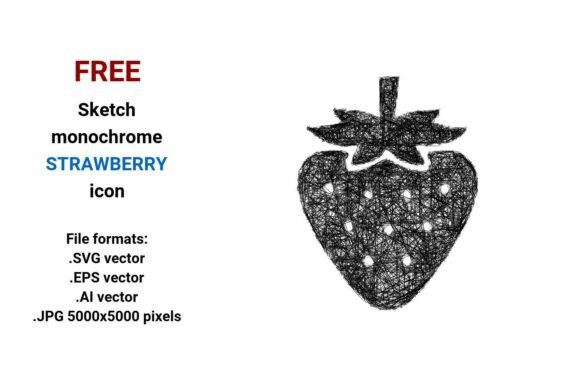
If you're designing a food blog, launching a jam brand, building a wellness app, or crafting an educational dashboard, a clean, expressive strawberry icon can add warmth and clarity—fast. The FREE Sketch Strawberry Icon delivers exactly that: a hand-drawn, minimalist line-art representation of a strawberry, designed not as decoration, but as functional visual language. It’s not overly stylized or cartoonish—it’s approachable, legible at small sizes, and versatile across interfaces.
What makes this resource especially useful is its availability in four professional file formats: .SVG vector, .EPS vector, .AI vector, and a high-resolution .JPG (5000×5000 pixels). That means whether you’re coding a responsive website button, prepping print-ready packaging, editing in Adobe Illustrator, or embedding into a presentation, you’ve got the right version—no pixelation, no guesswork.
Why “Sketch” Doesn’t Mean “Low Effort”—And Why That Matters
Some designers assume “sketch” implies roughness or unreliability—like a placeholder doodle rather than production-ready art. But a well-executed sketch style is intentional: it conveys authenticity, approachability, and human touch—ideal for brands emphasizing craft, health, or education. The FREE Sketch Strawberry Icon uses consistent stroke weight, balanced negative space, and clear berry strawberry anatomy (calyx, seeds, curvature) so it reads instantly as “strawberry,” not just “red blob.”
Mistake to avoid: downloading any “free strawberry icon” without checking if it’s truly vector-based. Many sites label raster images (like PNGs or low-res JPGs) as “scalable” — they’re not. Zoom in, and edges blur. That’s fine for social media posts, but disastrous for a logo on a trade-show banner or a crisp UI button in a medical app dashboard.
Format Confusion Is More Common Than You Think
Here’s what often goes wrong:
- Picking .JPG when you need vector — Even at 5000×5000 pixels, a JPG can’t scale infinitely. Use it only for static web banners, presentations, or email headers—not for logos, app icons, or SVG-powered animations.
- Assuming .EPS works everywhere — While .EPS is widely supported in print workflows, many modern web tools (Figma, Webflow, CMS editors) don’t import it cleanly. For digital use, .SVG is your safest, most flexible choice.
- Opening .AI files without Illustrator — Not everyone has Adobe Creative Cloud. If you’re a freelancer or educator using free tools like Inkscape or Vectr, stick with .SVG or .EPS (both open reliably), and treat .AI as a bonus for Adobe users.
Real example: A small-batch jam maker downloaded a “free strawberry clipart” from an unverified site—only to discover the .PNG had a white background and couldn’t be layered over her kraft-paper packaging design. She wasted two days manually removing backgrounds before finding the FREE Sketch Strawberry Icon in transparent .SVG format—ready to drop in and recolor in seconds.
Don’t Overlook What Makes This More Than Just “Another Strawberry Icon”
This isn’t generic fruit clipart. It’s built with UI/UX practicality in mind. The outline is optimized for readability at 24px (perfect for dashboard buttons or mobile navigation), the curves are smooth but not overly complex (so it renders cleanly on older devices), and the seed placement follows botanical logic—not random scatter—so it feels trustworthy, even at a glance.
That attention shows up where it counts: in brand consistency. Whether you’re pairing it with other berry icons (raspberry, blueberry) or using it alone as a strawberry button on a recipe filter, its clean line art aesthetic holds up alongside typography and photography—no visual competition, just quiet clarity.
Before You Download: 4 Quick Checks
- Is the background transparent? — Crucial for web and app use. All vector versions (.SVG, .EPS, .AI) include transparency; the .JPG does not. If you need white or colored backgrounds, add them yourself—don’t rely on the source file.
- Are strokes uniform and editable? — Open the .SVG in a code editor or browser dev tools. Look for
stroke-widthvalues—ideally consistent (e.g., 1.5–2px). Avoid icons where strokes vary wildly or are baked into shapes (they won’t resize cleanly). - Does it follow real berry strawberry structure? — A credible berry strawberry icon includes subtle calyx detail and evenly spaced, slightly oval seeds—not dots or blobs. This builds subconscious trust, especially in health, nutrition, or educational contexts.
- Is licensing clearly stated? — “Free” doesn’t always mean “unrestricted.” This FREE Sketch Strawberry Icon is licensed for personal and commercial use, including merch and SaaS dashboards—no attribution required. Always verify before embedding in client work.
Where This Icon Shines—And Where to Use It Thoughtfully
It excels in contexts where friendliness and clarity matter more than flash: food blogs, nutrition apps, school garden projects, wellness dashboards, and small-batch product labels. Its hand drawn icon quality softens technical interfaces without sacrificing professionalism.
Use it as a strawberry vector in Figma or Adobe XD to build interactive components—a hover effect on a “Strawberry Recipes” filter, or a checked-state icon in a meal-planning checklist. Pair it with a clean sans-serif font and muted palette, and you’ve got cohesive, accessible design—not just decoration.
Avoid forcing it into high-contrast, ultra-minimalist branding (think monochrome luxury skincare) unless you adjust the stroke weight and spacing deliberately. Its charm lies in gentle imperfection—not stark geometry. Know when to lean in, and when to choose a different style.
In short: the FREE Sketch Strawberry Icon is more than a download—it’s a thoughtful, production-ready tool. Choose the right format for your workflow, verify transparency and scalability, and let its simple, human-centered line art do the communicating. Whether you're a teacher building a fruit-themed lesson, a developer adding a berry strawberry button to a grocery app, or a marketer refreshing seasonal packaging—the time you save starts with getting the file right the first time.