Heron Silhouette Art: Minimalist Elegance for Nature Design
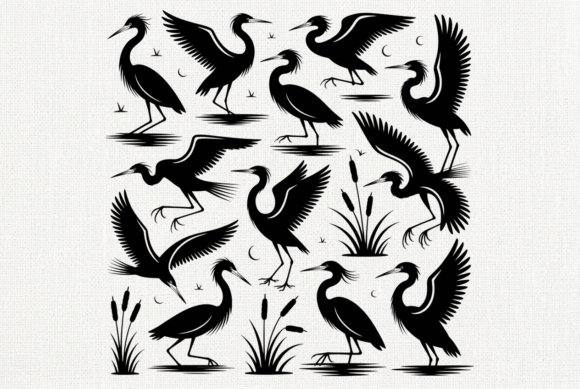
There’s a quiet power in simplicity—especially when it comes to visual storytelling. Heron Silhouette Art distills the poise and stillness of wading birds into clean, confident black-and-white vector forms. These aren’t generic bird outlines. Each piece in the Elegant collection reflects deep observation: a great blue heron mid-step through reeds, a sandhill crane lifting off with wings fully extended, or a pair of cranes mirrored in still water—all rendered with Japanese ma (intentional negative space) and Scandinavian restraint. The result? A design resource that communicates serenity, balance, and natural intelligence without a single color or detail competing for attention.
Why This Style Fits Real Creative Work—Not Just Aesthetic Trends
Designers, educators, and small business owners often face a tension: how to evoke nature meaningfully without cliché. Overly detailed wildlife illustrations can feel dated or busy; abstract symbols may lack emotional resonance. Heron Silhouette Art bridges that gap. Its minimalist approach isn’t about stripping away meaning—it’s about focusing it. Because these silhouettes are built as scalable vector files (SVG, EPS, PNG), they retain crispness whether sized for a 2-inch sticker or a 6-foot mural. That technical reliability saves hours in resizing, troubleshooting raster distortion, or commissioning custom redraws.
Consider a local conservation nonprofit launching a new wetland education campaign. Instead of licensing expensive stock photography or hiring an illustrator for custom icons, their team uses Heron Silhouette Art to build a cohesive visual language: a flying crane as a section divider in a printed field guide, a standing heron as the logo for their youth program, and layered reed-and-bird silhouettes as subtle background textures on presentation slides. Consistency emerges naturally—not from rigid branding guidelines, but from shared visual DNA.
Where Precision Meets Poetic Function
The elegance of this collection lies in its intentional limitations. No gradients. No textures. No forced realism. That constraint becomes a strength across use cases:
- Logos & Branding: A boutique eco-lodge uses a side-profile heron silhouette—head tilted slightly, neck curved—as its primary mark. It reads clearly at favicon size and scales flawlessly onto woven linen napkins and engraved wooden signage. Unlike photorealistic logos, it avoids seasonal or regional associations (e.g., “this looks like a Florida heron”), making it adaptable across geographies.
- Tattoos & Stickers: Tattoo artists appreciate how cleanly these silhouettes translate to linework and solid-fill placements. A client seeking a meaningful, non-literal symbol of patience or transition chooses a crane in flight—not because it’s “pretty,” but because its posture conveys upward motion without urgency. For sticker designers, the high-contrast black-on-transparent format prints crisply on matte vinyl, with no anti-aliasing blur around edges.
- Educational Materials: Science teachers use the wetland wildlife elements—cattails, lily pads, shallow water ripples—as contextual anchors in classroom posters. Because each element is drawn to the same scale and stylistic logic, students subconsciously grasp spatial relationships: “Herons stand *here*, not *there*.” That visual coherence supports learning better than mismatched clipart ever could.
Thoughtful Fit: When and How to Use These Silhouettes Well
Like any strong design tool, Heron Silhouette Art works best when matched to intention—not just aesthetics. It excels where clarity, calm, or quiet sophistication matters most. A high-energy fitness brand promoting “heron-inspired balance” might find the style too subdued; a mindfulness app or botanical apothecary, however, gains immediate tonal alignment.
Also consider context: because these are monochrome vectors, they rely on surrounding design choices for full impact. Pair them with ample whitespace, soft natural palettes (think oat, slate, or pale clay), or tactile materials like uncoated paper or linen canvas. Avoid pairing with aggressive sans-serifs or neon accents unless deliberately subverting expectations—a technique some contemporary tattoo studios use to contrast tradition and modernity.
One practical note: while the collection includes flying birds, most poses emphasize grounded stillness or slow, deliberate motion. If your project needs dynamic action—like a heron striking prey or wings beating mid-air—you’ll want to assess individual pieces closely. Not every silhouette prioritizes kinetic energy; many prioritize contemplative presence. That’s by design—and valuable for the right audience.
Supporting Creativity Without Overcomplicating It
For makers who juggle multiple roles—freelancers designing their own website while prepping craft fair inventory, educators building lesson plans after school hours—time is the most finite resource. Heron Silhouette Art reduces friction in tangible ways. There’s no need to trace, vectorize, or adjust contrast on found images. No licensing ambiguity (all files are commercially licensed for digital and physical use). No waiting for illustrator revisions.
A small-batch candle maker, for example, used three heron silhouettes—one upright, one mirrored, one inverted—to create a repeating border for soy wax melt packaging. She applied them in under ten minutes using Canva’s SVG upload, then exported print-ready PDFs. That same set later became the basis for a limited-edition enamel pin series, with zero additional art direction needed. The consistency wasn’t accidental—it came from starting with purpose-built, stylistically unified assets.
Who Benefits Most—and Why It’s Not Just About “Nature Lovers”
Yes, birdwatchers and ecologists respond strongly to these forms. But the deeper value reaches further. UX designers use the crane-in-flight silhouette as a subtle progress indicator in wellness apps—its upward arc suggests forward movement without implying speed or pressure. Interior stylists layer heron wall art with raw wood shelves and ceramic vases to anchor biophilic spaces without visual noise. Even publishers selecting cover art for literary fiction about migration or solitude turn to these silhouettes for their emotional precision: they suggest journey, stillness, and resilience in equal measure.
What ties these users together isn’t just subject matter—it’s a shared need for imagery that carries weight without clutter. In a world saturated with visual noise, Heron Silhouette Art offers a pause. Not as decoration, but as intention made visible.