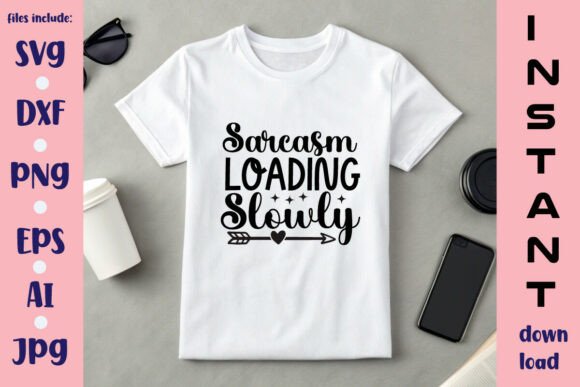
Sarcasm Loading Slowly SVG Design
If you’ve ever stared at a spinning wheel while waiting for a webpage—or a colleague’s sense of humor—to load, you’ll instantly recognize the dry, self-aware charm of the Sarcasm Loading Slowly SVG Design. It’s not just text on a screen. It’s a visual wink: a minimalist, slightly pixelated progress bar paired with the phrase “Sarcasm Loading Slowly…” rendered in a clean, low-contrast sans serif that mimics system UI fonts—yet deliberately undercuts its own seriousness with timing, spacing, and tone. The design leans into digital fatigue with empathy, not mockery. It feels human because it refuses to pretend everything loads instantly—or that every joke lands on cue.
Why This Design Fits Real Creative Workflows
This isn’t a decorative flourish you drop into a mockup and forget. The Sarcasm Loading Slowly SVG Design thrives where personality meets practicality—especially in projects where audience alignment matters more than polish. Think: a small-batch enamel pin brand teasing a restock, a newsletter footer acknowledging email delivery delays, or a conference slide deck poking fun at tech demos gone sideways. Its restrained aesthetic avoids clashing with established brand systems, yet carries enough tonal specificity to signal shared understanding. Unlike overly stylized script or aggressive display fonts, this design works *with* your layout—not against it.
It’s particularly effective in editorial design (think blog banners or social media carousels), packaging inserts for indie makers, or even as a subtle watermark on digital templates. Because it’s delivered as an SVG first—and backed by PNG, DXF, PDF, EPS, and AI files—it scales cleanly across formats without degradation. Whether you’re cutting vinyl decals for a coffee shop window, layering it into a Canva social post, or embedding it in a Figma prototype, the vector integrity holds. No fuzzy edges. No font substitution surprises. Just consistent, predictable output.
How It Performs Across Tools and Machines
You don’t need a design degree to use this—but knowing how the file types behave helps you skip troubleshooting later. The SVG is your go-to for web use, Cricut Design Space, or Silhouette Studio (when imported as SVG). The DXF ensures clean paths for laser cutters or CNC workflows. The PDF preserves layers and transparency for print prep. The EPS and AI files give Adobe users full editability—adjust stroke weight, tweak spacing, or isolate elements without rasterization. And yes, the PNG is there for quick drag-and-drop into PowerPoint, Google Slides, or Instagram Stories when vector support isn’t available.
All files are bundled in a single ZIP. That means no hunting through folders or re-downloading missing assets. But yes—you’ll need unzipping software like WinRAR or 7-Zip installed. It’s a small step, but one that prevents the very frustration this design humorously references. (No irony lost here.) These files are tested and confirmed compatible with Cricut Explore Air 2 and Maker, Silhouette Cameo 4 and 5, Brother ScanNCut SDX series, and most other major cutting machines that accept standard vector imports.
Where It Adds Quiet Value—Not Just Quirk
Typography isn’t just about legibility—it’s about pacing, expectation, and emotional calibration. The Sarcasm Loading Slowly SVG Design uses negative space, measured line height, and restrained weight contrast to create breathing room. That makes it surprisingly versatile in commercial contexts: it won’t overwhelm a product label, distract from a call-to-action button, or compete with photography in a lookbook. It supports hierarchy instead of hijacking it.
In branding, it functions best as a secondary or accent element—not a logo typeface, but the kind of detail that shows up in email footers, error pages, or limited-run merch. It reinforces brand voice without demanding attention. For content creators, it’s a reliable tone-setter: use it in tutorial videos to soften technical friction, or in blog graphics to acknowledge reader patience. For crafters, it’s a ready-made sentiment that resonates with audiences who appreciate wit over whimsy.
Practical Tips Before You Import
- Test before cutting: Open the SVG in your machine’s software and verify all strokes are set to “cut” (not “draw”) and grouped correctly. Some versions may include optional dashed-line guides—disable those if they interfere.
- Check scaling: Because it’s vector-based, resizing won’t distort it—but avoid extreme enlargement on intricate cuts (like fine text outlines) unless your material and blade allow it.
- Pair thoughtfully: This design pairs naturally with neutral sans serifs (Inter, Lato, Helvetica Neue) or light-weight geometric typefaces. Avoid heavy serifs or chaotic handwritten fonts—they dilute the dry, controlled vibe.
- Licensing clarity: This is a commercial-use design. You may use it in client work, sell physical products made with it (e.g., mugs, shirts, stickers), and include it in digital templates you license—no attribution required. You may not resell or redistribute the source files themselves.
- Readability note: While highly legible at medium sizes (16–48pt), avoid using it below 12pt in print or on low-resolution screens. Its charm relies on subtle spatial relationships—not micro-legibility.
What makes the Sarcasm Loading Slowly SVG Design endure isn’t just its humor—it’s how efficiently it communicates shared experience. In a landscape saturated with forced positivity and performative speed, it offers quiet recognition. That resonance translates directly into engagement: people pause, smile, remember. Not because it’s loud, but because it’s precise. Whether you’re designing for a startup’s first website, prepping a craft fair booth, or building a brand identity system, this asset earns its place—not as decoration, but as intentional punctuation.